

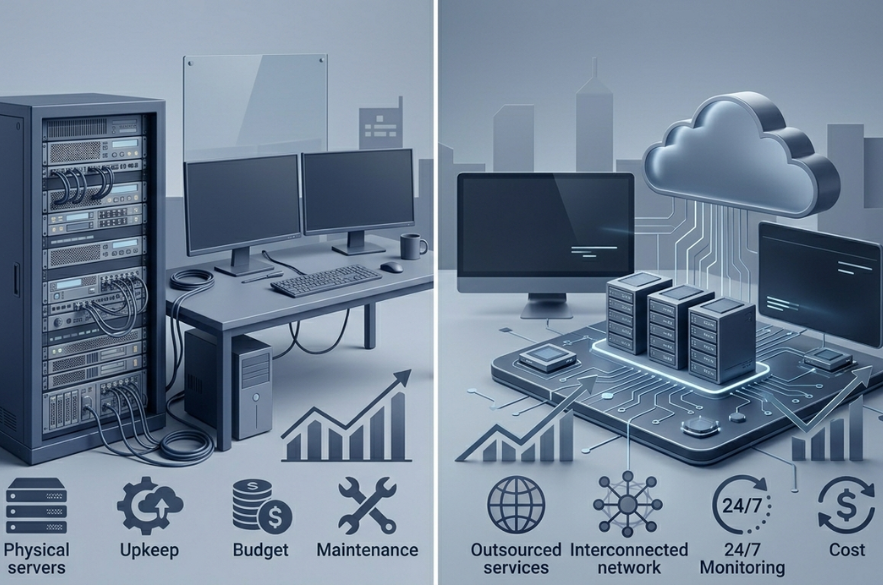
When something breaks, a dead laptop, a dropped connection, a suspicious email, your business needs it fixed fast. The question every growing UK company faces is how to resource that: build an in-house team, or partner with a Managed Service Provider (MSP)?
Both work. They just cost very differently once you look past the headline numbers. This guide breaks down the real figures for 2026, so the decision rests on data instead of guesswork.
The cost of hiring in-house
An internal hire starts with salary. In the UK in 2026, the median IT support technician earns £28,500 a year. In London it’s higher, around £29,400, roughly 10% above the national average.
But salary understates the real cost. A full-time hire also carries:
- Employer National Insurance and pension contributions
- Recruitment costs to secure technical talent
- Ongoing training and certifications
- Software and monitoring tools
- Cover gaps during holiday, sickness, and turnover
Add these up and one engineer costs far more than their salary. Industry analysis puts the true cost of a single in-house IT engineer at £30,000–£45,000 once NI, pension, training, and tools are included, about £150–£225 per user per month for a 20-person business.
That covers one person, business hours, one location.
The cost of a Managed Service Provider
An MSP delivers IT support for a fixed monthly fee per user. UK pricing in 2026 is well established across the market and falls into clear tiers:
- Basic support (help desk and monitoring): £40–£55 per user/month
- Standard support (adds security and backups): £55–£85 per user/month
- Comprehensive support (adds strategic planning and advanced security): £85–£150 per user/month
These bands hold consistent across multiple independent UK pricing guides for 2026. For a typical SMB, the standard tier covers what most businesses need.
The model also scales cleanly. A typical 30-person SME pays £1,350–£3,600 per month for managed IT, depending on the service level with cover, tools, and a full team built into that single figure.
What’s included matters as much as the price
The headline number only tells half the story. The real value is in what each model covers. A standard MSP package typically bundles services that an in-house setup would purchase separately:
- 24-hour monitoring and proactive maintenance
- Endpoint detection and response (EDR)
- Email security and filtering
- Backup and disaster recovery
- Patch management and updates
- A team of specialists rather than a single skillset
With an MSP, a managed contract provides broader expertise, guaranteed cover during holidays and sickness, and included cybersecurity tools, capabilities that would each carry their own cost in-house.
The cost of downtime
There’s one cost both models exist to prevent: your systems going down.
For an SMB, downtime is expensive. Reactive IT can cost a small business upwards of £500 per hour in lost productivity when systems fail and work stops.
This is where proactive support earns its keep. Continuous monitoring catches problems before they cause an outage, 24-hour monitoring, automated patch management, and rapid incident response are the baseline of a managed service. Prevention rarely shows on an invoice, but it’s often where the largest savings sit.
When each model fits
The right choice depends on the business.
An in-house team suits organizations that:
- Have enough scale (typically 50+ staff) to keep a full-time team occupied
- Build technology as their core product
- Require daily, hands-on physical presence
- Depend on immediate, on-site response
An MSP suits organizations that:
- Run lean teams of 10–50 staff
- Need broad expertise without multiple hires
- Want predictable, scalable monthly costs
- Treat IT as essential infrastructure rather than their core product
Many growing businesses combine both, a small internal team for day-to-day needs, with an MSP handling security, monitoring, and out-of-hours cover.
Choosing a provider with confidence
Not every quote is equal. When comparing MSPs, look for:
- Transparent pricing. Project work, out-of-hours support, and hardware can carry extra charges. Clarify what’s included up front.
- Security as standard. EDR, email filtering, and backup should be built in, not sold as add-ons.
- A UK-based help desk and a clear, written SLA with guaranteed response times.
- Realistic pricing. A quote far below the market average usually signals something has been cut.
The same care applies to hiring internally. The right fit, on either path, is the one that keeps your business running.
The bottom line
For most UK SMBs with 10–50 staff, an MSP delivers a full team, bundled security, and guaranteed cover for a predictable monthly cost, often below the true cost of a single in-house hire once every expense is counted.
For larger or build-focused businesses, an in-house or hybrid team earns its place.
The deciding question isn’t simply which costs less this month. It’s which model keeps your business secure, supported, and running when it matters most.
Ready to find your real number?
Every business is different, and the right IT model depends on yours. I-NET Software Solutions helps UK businesses compare the true cost of their IT and build support that fits, without the hidden extras.
Get a free, no-obligation IT assessment and see exactly what your IT should cost.