

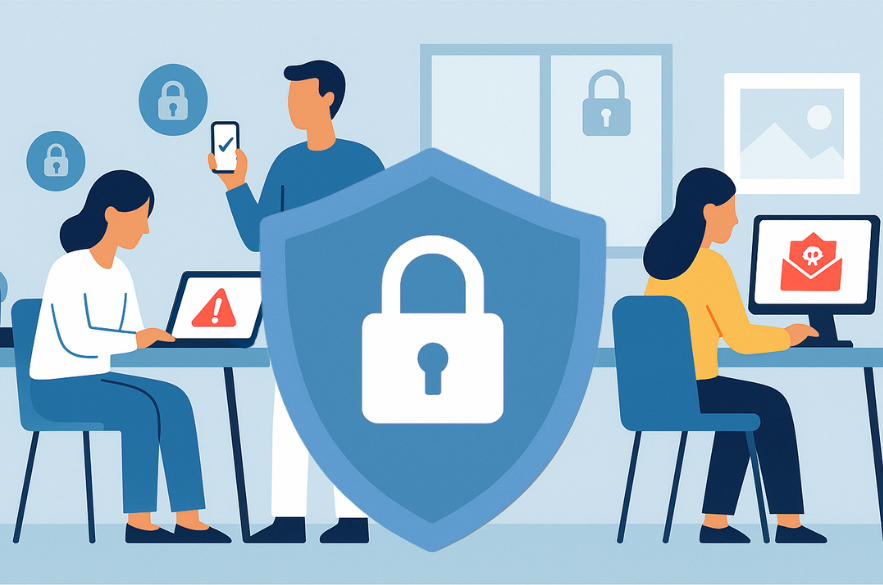
Building a Cybersecurity Culture: What It Looks Like in Small Team
Cybersecurity is no longer the sole domain of IT administrators. For small businesses, where staff often juggle multiple roles, security culture isn’t about having bigger budgets, it’s about smarter behaviour. A resilient cybersecurity culture turns every employee into a firewall. According to the UK Government’s Cyber Security Breaches Survey 2025, 82% of small businesses experienced a phishing or social engineering attempt, yet only 29% had conducted a staff-wide awareness training in the past 12 months. This disconnect between risk and response highlights a key insight: technical controls without cultural reinforcement are destined to fail. What Is a Cybersecurity Culture, Really? Cybersecurity culture refers to the collective mindset, behaviours, and routines of your team that determine how securely your organisation operates on a day-to-day basis. It’s not just policy, it’s practice. In smaller teams, this manifests in: The European Union Agency for Cybersecurity (ENISA) defines it as the “attitudes, knowledge, assumptions, norms, and values of workforce members regarding cybersecurity”, making it a people issue as much as a technical one. Why It’s More Critical for Small Teams Than Corporates Larger enterprises often absorb breaches with layered defences and budget-heavy incident response. SMBs, on the other hand, are more vulnerable due to: A report by Eurostat (2024) revealed that over 50% of data breaches in businesses with fewer than 50 employees were due to avoidable human error, not sophisticated hacking source: Eurostat What a Strong Security Culture Looks Like in Practice 1. Security Onboarding as Standard Every new hire, regardless of role, receives a security briefing tailored to their tools and data access. It includes: 2. Secure-by-Default Tools Using tools that encourage security best practices without friction: 2FA by default, role-based access, encrypted messaging (e.g. Signal or MS Teams with compliance layers). 3. “Psychological Safety” for Reporting Employees aren’t afraid to report mistakes, whether clicking a suspicious link or misconfiguring access. Incident response starts with open communication, not blame. 4. Visual Reminders, Not Just Policies Posters near workstations, pop-up tips in tools, and microlearning modules help maintain awareness. Behavioural reinforcement beats once-a-year training. Common Mistakes That Undermine Culture Even well-meaning SMBs sabotage their own efforts by: According to the European Union Agency for Cybersecurity’s Threat Landscape Report 2025, third-party vendors were linked to 17% of cyber incidents reported by SMEs, up from 11% in 2023. Case Example: A Small Legal Firm Adopts Cyber Culture In early 2025, a 12-person legal firm in Bristol faced an internal scare: a paralegal accidentally opened a malware-laced attachment disguised as a case file. No controls were bypassed, but the incident triggered a full review. Actions taken: Outcome: Within 3 months, phishing susceptibility dropped by 73% and a Cyber Essentials Plus certification was obtained, improving client trust and contract eligibility. Cybersecurity Culture Is a Competitive Advantage Small teams that embrace a security-first culture reduce breach risk, build customer trust, and even gain new business through compliance-readiness. And it’s not about fear. It’s about empowerment. SMBs that thrive in 2025 will be those where cybersecurity isn’t just a policy, it’s a shared, lived practice. Ready to See Where You Stand? At I‑NET Software Solutions, we partner with small business leaders to embed cybersecurity culture across teams, so every employee becomes a security-strength, not a weak link. Want to assess your team’s readiness and close the culture gap? Book a Cybersecurity Culture Assessment with our experts today. Recommended Read: If you found this article useful, check out our previous post on the evolving threat landscape: “Phishing 3.0: Advanced Email Scams Hitting UK Small Businesses in 2025”, it examines how modern multi‑vector attacks exploit cultural weaknesses in organisations just like yours.