

Growth exposes weaknesses that smaller organisations can temporarily ignore. A website that once felt “good enough” starts to fragment. New landing pages appear without consistency. Customer journeys diverge across channels. Accessibility becomes uneven. Internal teams make digital decisions in isolation. Over time, the business experiences the symptoms before it identifies the cause: lower conversion confidence, higher support friction, inconsistent brand perception, and slower digital delivery.
This is where UX governance becomes commercially important. In growing businesses, user experience design services should not be limited to interface improvement. They should help establish the standards, decision-making discipline, and operational consistency that allow digital experiences to scale properly. UX strategy is a plan of action that creates shared direction for improving an organisation’s user experience over time, which is precisely what governance formalises in practice. The issue is not whether UX matters. The issue is whether the business has a way to manage it deliberately.
Why UX Governance Matters More as a Business Grows
In an early-stage organisation, a small team can often maintain experience quality informally. Decisions are centralised, digital channels are limited, and inconsistency is easier to spot. Growth changes that.
More teams touch the customer experience. More systems feed into the digital journey. More campaigns, services, and product changes increase the risk of fragmentation. Without governance, UX quality becomes dependent on individual judgement rather than business standards.
That matters because experience quality is strongly linked to commercial performance. McKinsey’s research found that companies in the top quartile of its Design Index outperformed industry counterparts by 32 percentage points in revenue growth and 56 percentage points in total returns to shareholders over five years.
For a growing SME, that does not mean copying enterprise design structures. It means recognising that unmanaged user experience eventually becomes a growth constraint.
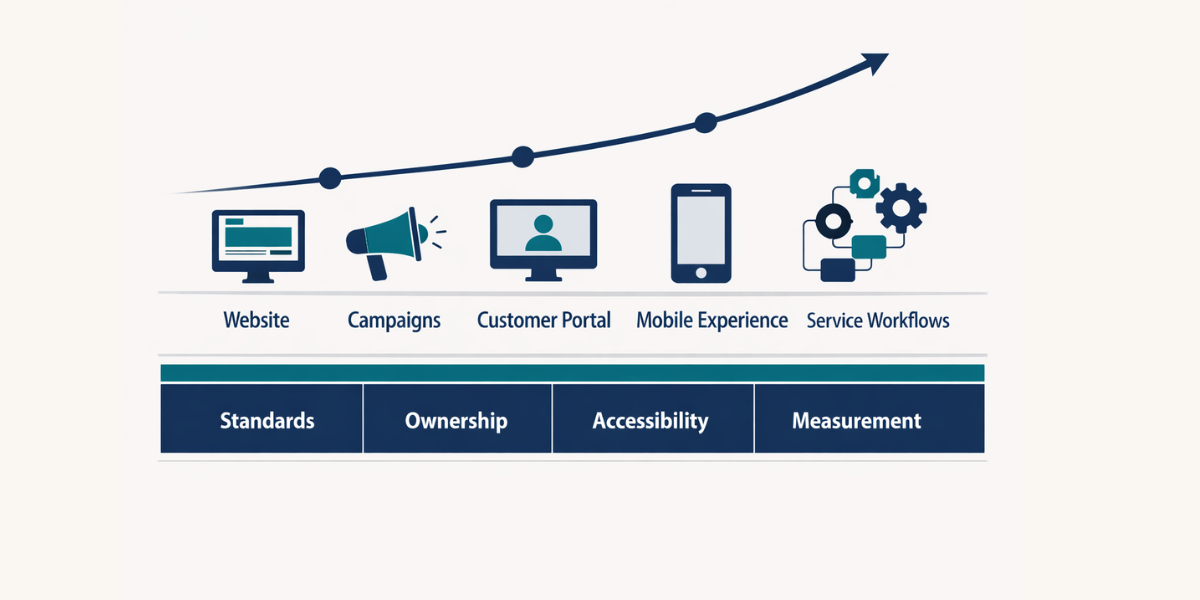
Good UX Governance Starts With Clear Ownership
One of the clearest signs of weak UX governance is that nobody can answer a simple question: who owns the experience?
That does not always mean a dedicated UX leader. In many SMEs, ownership may sit across marketing, digital, product, operations, or leadership teams. What matters is that accountability is visible and decision rights are clear.
Without ownership:
- inconsistencies multiply
- teams duplicate effort
- accessibility slips
- conversion issues persist without resolution
- customer feedback is not translated into design action
Governance creates a framework in which UX decisions are not made in isolation. It defines who approves patterns, who prioritises improvements, who maintains standards, and who reviews performance.
This is particularly important in B2B environments where digital journeys often span multiple touchpoints. UX is not just what happens on the website home page. It includes forms, onboarding, support flows, portals, service interactions, and all of the friction between them.
Standards Matter More Than Style Guides
Many businesses assume governance means documentation. In reality, documentation is only one output. Good UX governance relies on standards that shape execution consistently. These may include:
- design patterns for forms, navigation, and calls to action
- accessibility requirements
- tone and microcopy rules
- user journey conventions
- page template logic
- decision criteria for new digital features
The point is not creative restriction. It is operational consistency.
This is where the distinction between design and governance becomes important. Design creates solutions. Governance makes sure those solutions remain coherent as the organisation evolves.
That coherence matters commercially. Forrester reported in 2024 that customer-obsessed organisations achieved 41% faster revenue growth, 49% faster profit growth, and 51% better customer retention than non-customer-obsessed organisations. While customer obsession is broader than UX alone, consistent digital experience is part of how that standard is delivered.
Accessibility Cannot Sit Outside Governance
Accessibility is often treated as a compliance check performed at the end of a project. That is a weak governance model.
In a growing business, accessibility should be embedded into the standards that shape design and content decisions from the outset. GOV.UK guidance is explicit that services must be accessible and that organisations may be breaking the law if they do not make digital services accessible. GOV.UK also frames accessibility around making services perceivable, operable, understandable, and robust, reflecting WCAG principles. For commercial businesses, the practical implication is simple: if accessibility is not governed, it becomes inconsistent.
That creates risk in several forms:
- legal exposure
- reputational damage
- avoidable exclusion of users
- increased support burden
- reduced task completion
Governance ensures accessibility is not dependent on who happened to build a page or publish a campaign.
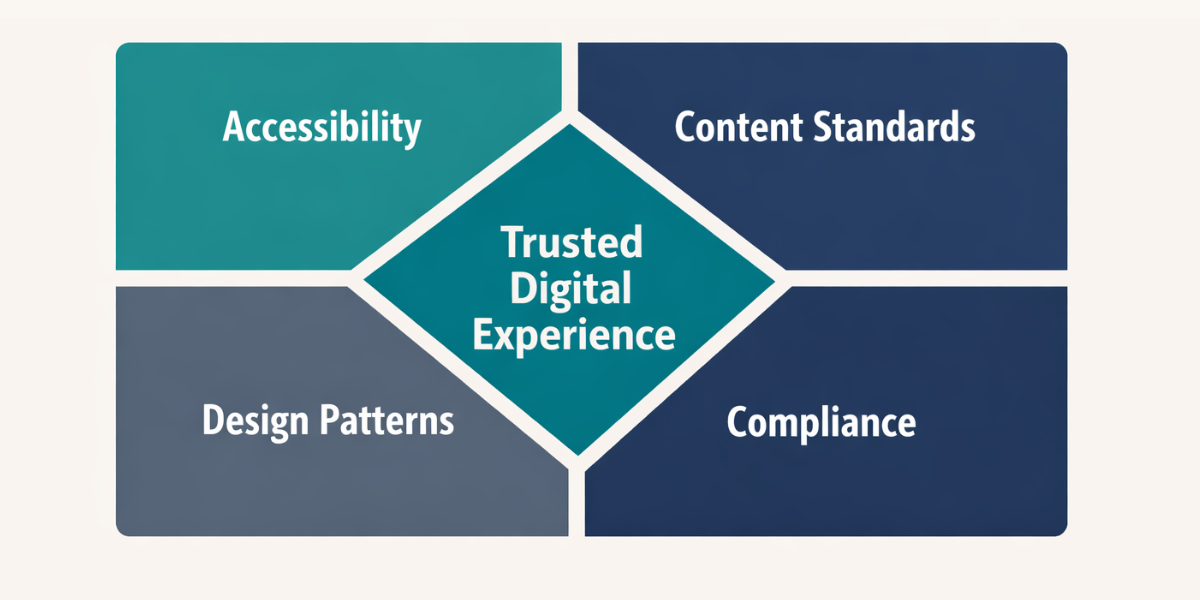
Measurement Is What Makes Governance Real
Governance that cannot be measured usually degrades into opinion. Strong UX governance includes a measurement model. That does not need to be overly complex, but it should connect experience quality to business outcomes. Leadership should demand rigour in how design value is discussed and measured, balancing quantitative and qualitative evidence.
In practical terms, a growing business should be monitoring indicators such as:
- conversion friction
- form abandonment
- navigation success
- user task completion
- support contact drivers
- accessibility issues
- consistency across templates and journeys
This is where user experience design services should move beyond page-level design work. Mature support means helping the business build a repeatable framework for identifying where experience quality is helping growth and where it is holding it back. Without measurement, businesses tend to redesign reactively. With governance, they improve deliberately.
Governance Also Speeds Up Delivery
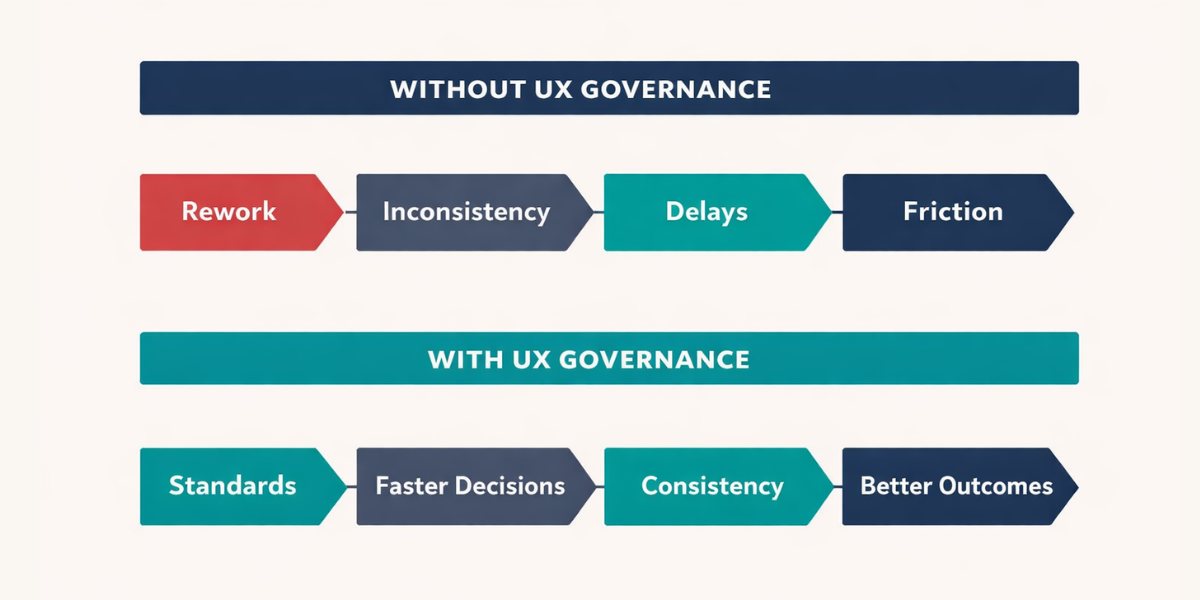
There is a persistent assumption that governance slows teams down. In reality, weak governance is usually what causes rework. When standards are unclear, teams redesign common elements repeatedly. Approval processes become inconsistent. Accessibility issues are discovered late. Messaging varies by department. Development effort goes into solving problems that should already have agreed answers.
Good governance reduces this waste. Mature organisations strengthen processes, leadership support, and longevity around UX, not just design output. That is a useful lens for growing businesses: governance is what turns UX from a set of isolated improvements into an organisational capability. For SMEs, this can be especially valuable because lean teams cannot afford duplicated effort.
What Good UX Governance Looks Like in Practice
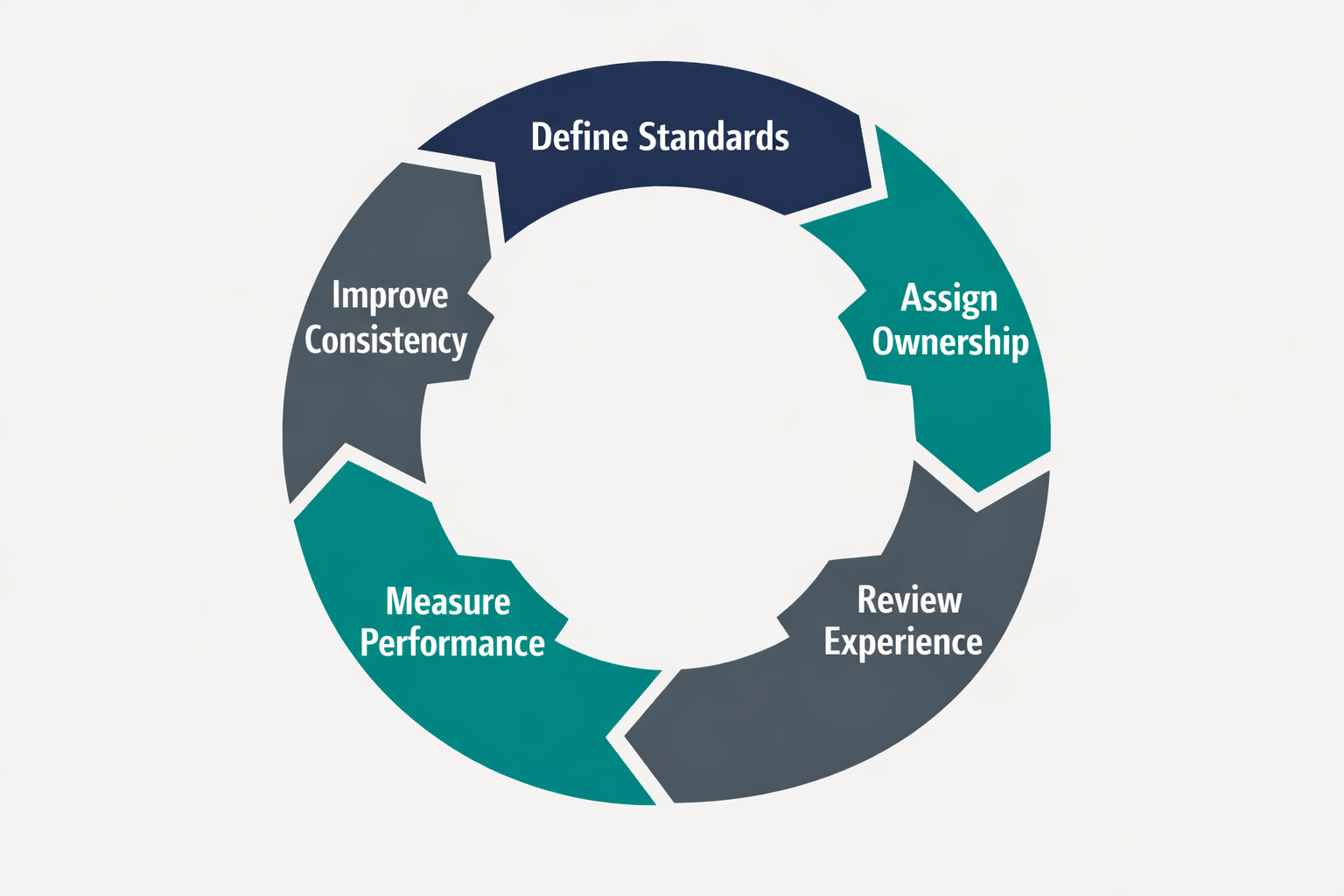
In a growing business, good UX governance is rarely a large formal programme. More often, it is a practical operating model with five visible characteristics.
1. There is a shared UX direction
The business has an agreed view of what good experience should deliver and how it supports commercial objectives.
2. Standards are documented and used
Patterns, templates, and accessibility expectations are defined clearly enough to guide day-to-day execution.
3. Decision-making is owned
The organisation knows who approves changes, who maintains standards, and how priorities are set.
4. Experience quality is measured
UX is reviewed through real operational and customer metrics, not personal preference alone.
5. Improvement is ongoing
The business treats UX as a managed capability rather than a one-off project.
The Risk of Waiting Too Long
Many businesses only formalise UX governance after digital inconsistency becomes visible enough to damage performance.
By that stage, the symptoms usually include:
- declining landing page effectiveness
- disconnected customer journeys
- duplicated digital effort
- inconsistent interfaces across products or services
- avoidable support requests
- accessibility debt
The challenge is that these issues often appear unrelated when viewed individually. Governance is what reveals them as part of the same operational problem. The real cost is rarely one bad page. It is the cumulative drag created by unmanaged experience quality.
What This Means for Growing Businesses
As businesses scale, the quality of the user experience stops being a design issue and becomes a management issue. That shift matters, it means user experience design services should no longer be judged only by the quality of screens or prototypes. They should be assessed by whether they help the organisation create consistency, improve decision-making, support accessibility, and strengthen digital performance over time.
Growth increases complexity. Governance is how a business prevents that complexity from becoming customer friction. In that sense, good UX governance is not about adding process for its own sake. It is about making experience quality sustainable.
Evaluating Whether Your UX Is Governed or Just Evolving Informally
Many businesses assume they have UX governance because digital work is still getting delivered. The better question is whether that delivery is consistent, measurable, and scalable.
I-Net Software Solutions helps UK businesses evaluate how user experience is currently being managed across websites, journeys, interfaces, and digital touchpoints. That includes identifying where inconsistency, accessibility risk, conversion friction, and unclear ownership may already be affecting performance.
For growing organisations, a structured UX review often creates the clarity needed to decide whether the next priority is standardisation, optimisation, accessibility improvement, or broader experience strategy.
FAQs
Recommended Read
- What Good UX Governance Looks Like in a Growing Business

- AI for SMEs: Practical Ways Small Businesses Can Use AI Today

- The Complete Guide to Ransomware Protection for UK Businesses (2026)

- What Should UK SMBs Expect from UI UX Design Services in 2026?
- A Practical Data Governance Framework for SMBs
- Why Passing Cybersecurity Compliance Doesn’t Mean You’re Secure